
0
  • WHY CHOOSE LOADRITE?
  • Register a Trailer
  • Dealer Portal
  • Contact
  • Trailers
  • Parts
    • Axle Assemblies & Parts
    • Lights & Electrical
    • Hull Support Systems
    • Spare Tire Carriers
    • Braking
    • Springs, Supports & Bushings
    • Couplers & Tongue Jacks
    • Trailer Accessories
    • Fender Components
    • Wheel Assemblies & Components
    • Frame Components
    • Winch Stand Parts
    • Hardware
  • Trailers 101
  • Resources
    • FAQs
    • Trailer Parts Store
    • Service Videos
    • Documents
    • Warranty Information
  • About
    • Why Choose Load Rite?
    • News
    • Become a Dealer
  • Blog

Boat Trailers

  • Boat Trailers
  • Bunk Models
  • Roller Models
  • Skiff/Jon Boat Trailers
  • Catamaran Trailers
  • Canoe/Kayak Trailers
  • Ski Boat & Inboard Trailers

Personal Watercraft
(PWC)

  • Personal Watercraft Trailers

Pontoon Trailers and Tritoon Trailers

  • Pontoon Trailers
  • Tritoon Trailers

Specialty & Custom

  • Utility Trailers
  • Custom Trailers
  • Sailboat Trailers
  • Australian Certified Trailers
  • Shipping & Storage Cradles
 |
How to Choose the Right Forklift Battery in 2026

How to Choose the Right Forklift Battery in 2026

Choosing a Forklift Battery in 2026 is not simply a choice between lead-acid and lithium-ion. The right fit depends on shift length, load weight, charging access, ambient temperature, and operator routines. A battery that looks economical on a quote may require spare units, extra charging time, or changes to the charging area. Small details matter. A cold-store truck and a two-shift warehouse rarely have the same energy needs.

Industry figures offer context, not a ready-made answer. BloombergNEF’s 2024 Lithium-Ion Battery Price Survey reported a global average pack price of $115 per kilowatt-hour, down 20% from 2023. That figure covers battery markets broadly; it is not a quoted price for an industrial forklift battery. MHI’s 2024 Annual Industry Report also documented continued investment in supply-chain technology, including automation. Together, these reports point to changing equipment and energy economics, but neither can predict a site’s actual operating cost.

A sound comparison should use measured energy consumption, charging windows, warranty terms, expected cycle life, and local service support. Ask suppliers to explain assumptions behind runtime and lifespan estimates. Request a duty-cycle test where practical, and check whether the charger, connector, and truck are compatible. Pay attention to the awkward bits: peak demand charges, battery-room constraints, and downtime during maintenance. They are easy to overlook. No spreadsheet captures every shift disruption, and vendor projections deserve scrutiny. This guide helps buyers assess the evidence, ask better questions, and choose a battery suited to real operations.
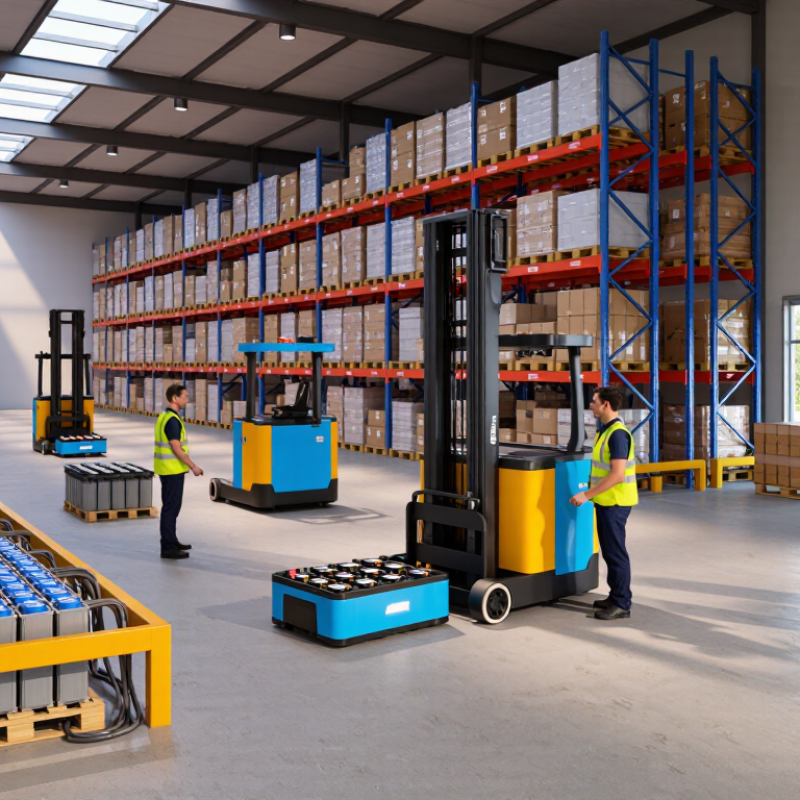
How to Choose the Right Forklift Battery in 2026
Table of Contents [Hide]
1 Identify Your Forklift’s Battery Requirements
2 Compare Battery Types and Their Operating Characteristics
3 Match Battery Capacity to Workload and Shift Patterns
4 Check Charger Compatibility, Space, and Safety Needs
5 Evaluate Total Cost, Service Life, and Supplier Support

Identify Your Forklift’s Battery Requirements

Start with the forklift’s data plate and operator manual. Record the required voltage, battery dimensions, maximum battery weight, and connector type. These are basic fit checks, not minor details. A battery that is too light may affect counterbalance, while one that is too large may not fit the compartment.

Next, match battery capacity to the workday. Note typical shift length, travel distance, lifting frequency, and time spent waiting or charging. A truck moving pallets across a large warehouse has different needs from one making short trips in a cool loading area. Check the charger’s output and available charging windows, too. Measure twice. Charging habits matter.

Battery chemistry also affects daily routines. Some types may support brief charging breaks, while others require a different charging schedule or maintenance plan. Confirm compatibility with the forklift and charger before selecting a battery; do not rely on appearance or capacity alone. If the truck runs longer than expected, review actual operating records rather than guessing from a busy day. And be honest about the uncertainty: workload changes by season, and one week of observation may not represent the whole year. A qualified technician can verify fit, electrical requirements, and safe handling procedures.

Compare Battery Types and Their Operating Characteristics

Forklift batteries differ most in charging, maintenance, and how consistently they deliver power through a shift. Conventional flooded lead-acid batteries are familiar and often suit predictable, single-shift work. They need scheduled charging, cooling time, and regular electrolyte checks. Missed watering matters. Battery changes can also require space and handling equipment.

Lithium-ion batteries can accept opportunity charging during breaks, which may help fleets running multiple shifts. They generally need less routine maintenance, but require a compatible charger and careful temperature management. Frequent short charges are convenient; they do not remove the need to monitor battery condition. Cold storage can reduce available performance. A paper comparison can still mislead.

Hydrogen fuel-cell systems can support long operating hours with brief refueling, but require dedicated fueling equipment and careful site planning. They may fit high-utilization operations better than smaller fleets. Compare each option against actual shift length, lift loads, travel distance, and charging access. Track battery temperature and voltage during a busy week, not just a quiet day. That detail is easy to overlook. A forklift that lifts heavy loads repeatedly may need a different capacity than one making short, light trips.

Match Battery Capacity to Workload and Shift Patterns

How to Choose the Right Forklift Battery in 2026

Match Battery Capacity to Workload and Shift Patterns

Battery capacity should reflect the work, not just the truck’s specifications. Estimate energy use across a full shift, including travel, lifting, and idle time. A truck moving heavy pallets up a ramp will draw more power than one handling light loads on a smooth floor. Check the battery’s rated amp-hour capacity, then compare it with measured shift consumption. Leave a practical reserve. Cold rooms, older batteries, and frequent acceleration can reduce available runtime.

Shift patterns matter just as much. Battery Council International’s industrial battery guidance describes the common lead-acid routine: about eight hours for charging, followed by cooling before reuse. That can make one battery per truck unsuitable for continuous, multi-shift work. Opportunity charging may help, but only if the battery and charging system support it. Small details matter. A short lunch break cannot replace a full recharge.

Tips: Log battery state of charge at shift start and finish for several days. Compare the results with the busiest shift, not the average one. If operators regularly return with little reserve, review capacity, charging access, and workload assumptions. The first estimate may be wrong; actual shift records are a better guide.

Choosing Forklift Battery Capacity by Shift Pattern

Illustrative planning estimates compare energy used during a shift with the nominal battery capacity needed to cover it.

Estimates assume an average draw of 5 kW per operating hour and that 80% of nominal battery capacity is available for planned work. Actual usage depends on the truck, load, operating conditions, battery type, and charging opportunities; use measured energy consumption to size a fleet.

Check Charger Compatibility, Space, and Safety Needs

Choosing a forklift battery starts with charger compatibility, not chemistry alone. Match nominal voltage, connector type, polarity, charge profile, and permitted output current. Check whether the battery requires communication with the charger’s management system. A plug that fits is not proof of compatibility. Compare both nameplates and confirm the proposed charging routine with the equipment supplier. Fast charging may reduce battery swaps, but only when the battery and charger are designed for it.

Space is easy to underestimate. Measure the battery tray, including its length, width, height, cable clearance, and lifting access. Then confirm the installed battery’s weight works with the truck’s rated capacity and balance requirements. The International Energy Agency’s Global EV Outlook 2024 reports that EV battery demand reached about 750 GWh in 2023, up 40% from 2022. That signals a rapidly growing battery market, not a guarantee that any battery suits a forklift. Measure twice.

Safety needs depend on chemistry and the charging area. Lead-acid charging can release hydrogen, so follow ventilation and charging-area requirements; provide suitable spill response and eyewash facilities. For lithium-ion systems, use the battery maker’s charging and emergency-response instructions, and keep the area clear of combustible materials. A site checklist helps, but it can miss real-world constraints, like a charger placed beside a busy aisle. Walk the route and inspect the actual space before ordering.

How to Choose the Right Forklift Battery in 2026 — Check Charger Compatibility, Space, and Safety Needs
Battery type Charger compatibility Space and fit Charging and shift suitability Maintenance needs Safety considerations Best fit when…
Flooded lead-acid Use a charger matched to the battery’s nominal voltage, capacity, and charging profile. Do not assume an existing charger is suitable without checking its settings. Confirm the battery compartment’s length, width, height, and permitted battery weight. The battery also needs suitable access for routine inspection and watering. Often suited to planned charging periods and battery changes between shifts. Frequent partial charging may affect service life unless the battery and operating plan are designed for it. Requires regular electrolyte-level checks and watering with the specified water, plus cleaning and inspection. Follow the battery maker’s charging and equalization guidance. Charging can release hydrogen gas, so use a designated, well-ventilated charging area. Wear appropriate protective equipment when servicing electrolyte. There is time and space for routine maintenance and a properly ventilated charging area.
Sealed lead-acid (AGM) Requires a charger profile suitable for the specific AGM battery. A charger intended for flooded batteries may not be appropriate. Check the same compartment dimensions, weight limits, terminal layout, and restraint requirements as for any replacement battery. Charging times and suitability for partial charging depend on the battery design and charger. Confirm the duty cycle with the battery supplier. Does not require routine water additions, but still needs inspection, correct charging, and cleaning in line with the manufacturer’s instructions. Sealed construction does not mean risk-free: batteries can vent under abnormal conditions. Follow ventilation, handling, and charging instructions. Reduced watering work is useful, and the battery’s capacity and charging profile match the truck’s workload.
Lithium-ion (LFP) Use a charger explicitly approved for the battery’s chemistry, voltage, and battery-management system (BMS). Check communication and connector requirements as well as the charging profile. Verify dimensions, weight, mounting, center-of-gravity limits, connector position, and any required counterweight provisions. A smaller battery must not compromise truck stability. Many systems support shorter or more frequent charging, including opportunity charging, when permitted by the battery and charger specifications. Confirm that the planned charging pattern is approved. Typically avoids electrolyte watering. Follow instructions for inspection, diagnostics, temperature limits, storage, and BMS alerts. Use the supplied charging and emergency procedures. Do not charge a damaged battery; have faults assessed by qualified personnel. High utilization or multi-shift work benefits from the system’s approved charging flexibility, and the truck supports the battery installation.
Fit and compatibility check for any battery Match nominal voltage, chemistry-specific charging requirements, connector, polarity, and any required charger-to-battery communications. Measure the battery compartment and check the truck manufacturer’s permitted battery weight range, dimensions, restraint, and center of gravity. Estimate daily operating hours, breaks, charging windows, and whether a spare battery or battery-change area is needed. Compare scheduled labor and service requirements with the site’s maintenance capacity. Plan for the battery’s charging-area, ventilation, handling, and emergency-response requirements before installation. Before purchase or retrofit, the truck and charger documentation confirms the battery is an approved match.

Important: Battery dimensions, capacity, charging time, and compatibility vary by model. Confirm the forklift manufacturer’s approved battery specifications and the battery and charger manufacturers’ instructions before selecting or installing a battery.

Evaluate Total Cost, Service Life, and Supplier Support

Choosing a forklift battery in 2026 means comparing more than purchase prices. Estimate total cost across its expected service life, including the battery, charger compatibility, energy use, maintenance, and replacement labor. A lower quote can become expensive if it requires extra charging equipment or causes frequent downtime.

Record daily operating hours, shift patterns, and available charging windows. Real schedules matter. Battery life varies with temperature, discharge depth, charging habits, and workload. Treat supplier estimates as assumptions, not guarantees, and ask what test conditions support any cycle-life figure.

Tips: Request an itemized quote, written warranty terms, and a clear service response target. Confirm whether technicians can reach your site and whether common parts are available nearby. Compare cost per operating hour, not just cost per battery.

Supplier support is part of the investment. Ask who diagnoses faults, how quickly help is available, and what happens if a battery is unavailable during a busy shift. Check whether operators and maintenance staff receive practical guidance on charging and inspections. A reliable supplier should explain trade-offs without promising perfect results. Review your figures after a few months, too; early estimates can miss idle time or seasonal workload changes.

Article Source:

  • Uav Drone Charger
  • Forklift Battery
  • Trailers
  • Parts
  • About
  • Contact
  • Find a Dealer
1-800-LOADRTE
©2017 - 2025 Load Rite Trailers, Inc
  • Terms & Conditions
  • Privacy
  • Site Map